

Qunoot e Nazilah Continues During Ramadan
بِسْمِ اللّٰهِ الرَّحْمٰنِ الرَّحِيم
In the name of Allah, the Most Gracious, the Most Merciful
In moments when the Ummah faces hardship, uncertainty, or collective distress, Qunoot‑e‑Nazilah becomes far more than a supplication recited within prayer. It is a profound and sacred prophetic tradition — a turning of the heart toward Allah — practiced by the Messenger of Allah ﷺ whenever calamity touched the Ummah.
Through this special dua, we stand in humility before Allah, recognising that all comfort, safety, and justice come only from Him. It is a moment when hearts soften, faith deepens, and the community unites in seeking divine mercy, protection, and relief.
The Qur’an repeatedly urges believers to turn to Allah in times of trial, reminding us that hardship is not abandonment. Rather, it is an invitation to stand closer to our Creator. Allah assures us of His nearness to those who call upon Him (Surah Al‑Baqarah 2:186), instructs us to seek help through patience and prayer (Surah Al‑Baqarah 2:153), and teaches that nothing afflicts a believer except by His perfect and wise decree (Surah At‑Tawbah 9:51). These verses embody the spirit of Qunoot‑e‑Nazilah: standing before Allah with certainty in His promise, trust in His wisdom, and hope in His mercy.
Historical Origins of Qunoot‑e‑Nazilah
The practice of Qunoot‑e‑Nazilah is deeply rooted in Islamic history. One of the earliest and most notable incidents occurred after the tragic event of Bi’r Maʿunah, where a group of Qur’an reciters were martyred while carrying out a peaceful mission. The Prophet ﷺ, grieved by the injustice, recited Qunoot for an entire month, seeking Allah’s aid and protection for the believers. This moment is preserved in Sahih al‑Bukhari (Hadith 1003) and Sahih Muslim (Hadith 675).
Other narrations speak of the Prophet ﷺ reciting Qunoot during battles, in the face of oppression, and at times when the Muslim community faced existential threats. Companions and scholars after them continued this practice whenever calamities unfolded, whether due to injustice, famine, illness, or war. In cities across the centuries — from Madinah to Damascus, Baghdad to Cairo, Istanbul to Delhi — Qunoot‑e‑Nazilah became a unifying response to hardship, strengthening the resolve and faith of the Muslim communities who recited it.
Qunoot‑e‑Nazilah in Modern Times
As the world has grown more interconnected, so too has the awareness of the Ummah’s shared trials. Modern scholars continue to endorse Qunoot‑e‑Nazilah during times of global and regional crises — whether due to humanitarian disasters, persecution, war, or the suffering of vulnerable populations.
Today, mosques and communities around the world recite Qunoot‑e‑Nazilah in response to injustice and hardship affecting Muslims across the globe. It is a reminder that the Ummah remains spiritually connected, even when separated by borders. In an age of constant news and rapid communication, Qunoot‑e‑Nazilah serves as a grounding act that transforms concern into worship, grief into prayer, and solidarity into action.
Qunoot‑e‑Nazilah at Balham Masjid & Tooting Islamic Centre
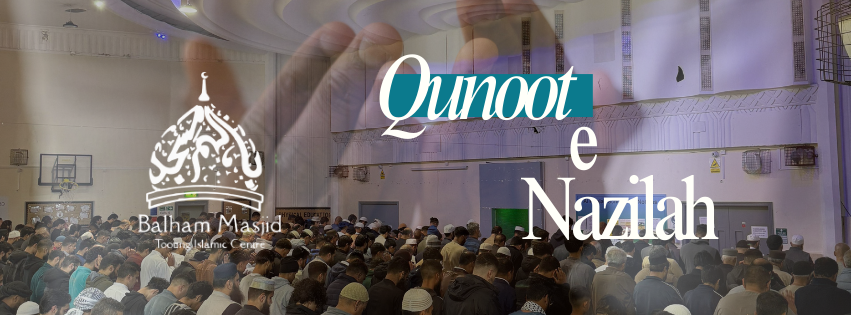
At Balham Masjid & Tooting Islamic Centre, this prophetic tradition holds a special place in our communal worship. In response to the ongoing difficulties faced by the global Ummah, Qunoot‑e‑Nazilah has been recited at Tooting Islamic Centre, every Friday at Fajr since November 2025, and this practice will continue throughout the month of Ramadan, in shā’ Allāh.
These moments of collective dua bring our community together in humility, compassion, and shared concern for those suffering around the world.
For us, Qunoot‑e‑Nazilah is more than a ritual — it is a living expression of empathy, justice, and unity. It calls upon us not only to pray, but also to embody the Prophetic teaching that “the believers, in their love, mercy, and compassion for one another, are like one body” (Sahih al‑Bukhari 6011; Sahih Muslim 2586).
When one part of this global body suffers, the rest respond — through prayer, charity, support, and sincere concern.
May Allah accept our supplications, grant relief to those afflicted, protect the oppressed, strengthen the Ummah, and fill our hearts with compassion, steadfastness, and faith. Ameen.